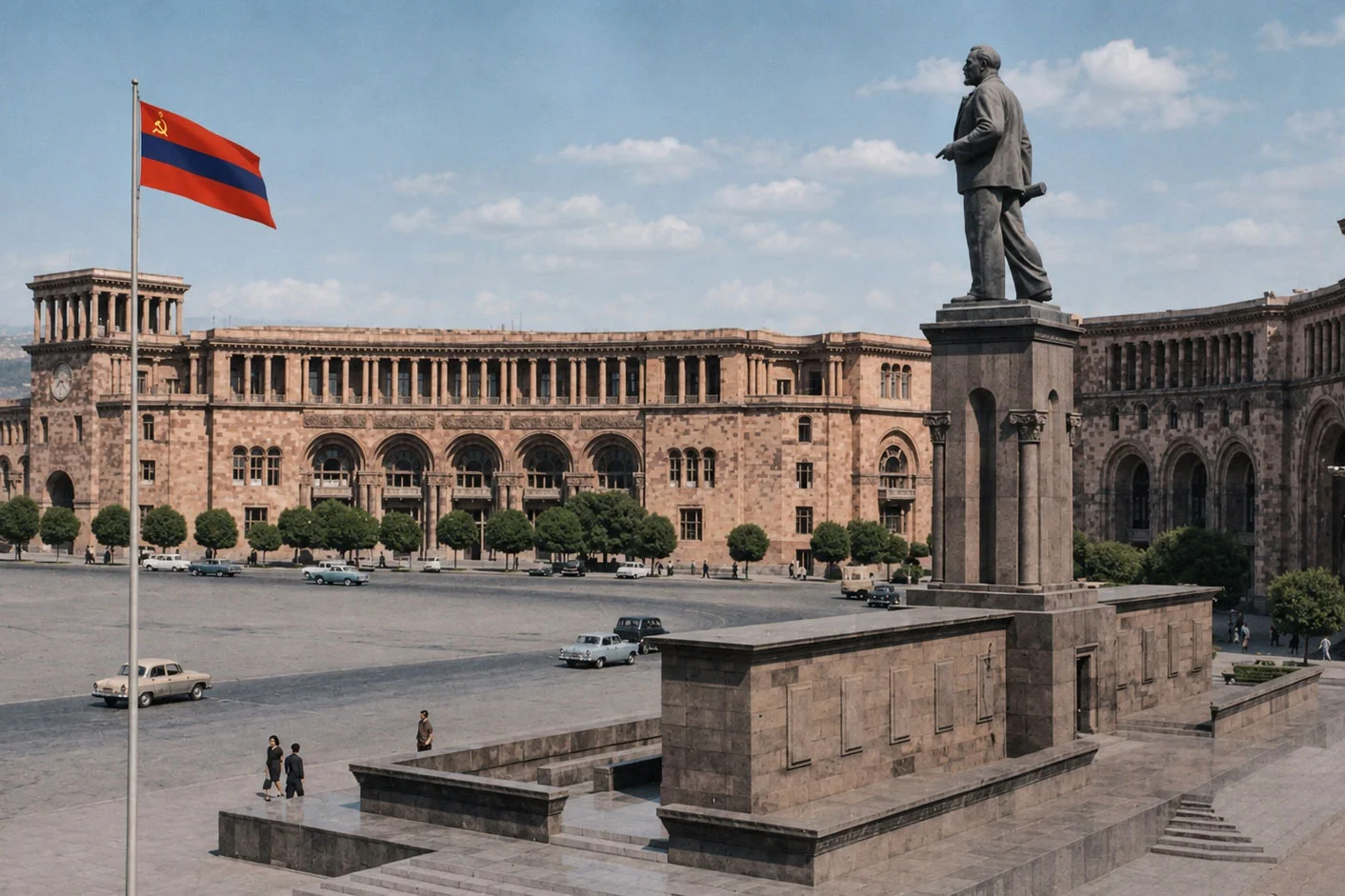
Yes. For seventy years the red flag flew over Yerevan, and you cannot make sense of modern Armenia without those seven decades. The Russian fluency, the metro, the pink-stone government buildings, the diaspora’s relationship with the homeland, all of it passes through the Soviet chapter.
How Armenia became Soviet
The sequence matters, because Armenia didn’t join the USSR from independence by choice. It was absorbed at the lowest moment in its history.
The First Republic of Armenia declared independence on May 28, 1918, as the Russian Empire disintegrated. It was a state born on fire: flooded with starving genocide survivors, at war with neighbors on multiple fronts, and broke. In late 1920, squeezed between a Turkish army advancing from the west and the Red Army arriving from the east, the government ceded power to the Bolsheviks. Sovietization was complete by December 1920, with a final anti-Soviet uprising crushed in 1921.
From 1922 Armenia was packed into the Transcaucasian federation with Georgia and Azerbaijan, one of the four founding units of the USSR. The 1936 Soviet constitution split the federation, and the Armenian Soviet Socialist Republic stood as a union republic in its own right, the smallest of the fifteen by area, about the size of Belgium.
What Soviet rule did to Armenia
Two opposite things at once, which is why Armenians still argue about it.
It built. A rural, traumatized country industrialized fast: chemicals, machine tools, electronics, and eventually a reputation as one of the USSR’s high-tech workshops. Yerevan grew from a dusty provincial town of 30,000 into a planned capital of more than a million, laid out in rose-colored tuff stone. Literacy became universal. An observatory, an academy of sciences and a film industry appeared. For a people that had just survived annihilation, the ArmSSR offered something not nothing: a protected national home, with Armenian remaining the language of schools and daily life.
It also crushed. Stalin’s purges executed or deported tens of thousands of Armenians, including much of the intellectual class the genocide had spared. The church was strangled, nationalism criminalized, and the genocide itself went publicly unmentionable for decades, until mass protests in Yerevan in 1965, on the 50th anniversary, forced the construction of the Tsitsernakaberd memorial.
And it drew borders that still bleed: Moscow’s decision to place Nagorno-Karabakh, with its Armenian majority, inside Soviet Azerbaijan set the fuse for the wars that followed, as covered in what is Nagorno-Karabakh.
How it ended
Fast and brutally. In February 1988 the Karabakh movement brought hundreds of thousands into Yerevan’s squares, the first mass democracy movement in the late USSR. In December 1988 the Spitak earthquake killed at least 25,000 people and flattened Armenia’s second cities while the union that was supposed to rebuild them was itself collapsing.
On September 21, 1991, Armenians voted in a referendum, over 99 percent yes, and independence was declared two days later. September 21 remains Independence Day. Not the first Armenian independence, but the one that stuck, and this time with the state surviving its brutal first decade of blockade, war and blackout winters.
The Soviet inheritance is still everywhere: in the second language, in the industrial ruins and the metro stations, in the dram replacing the ruble only in 1993, and in the long, unfinished project of pivoting away from Moscow that defines Armenian politics today.