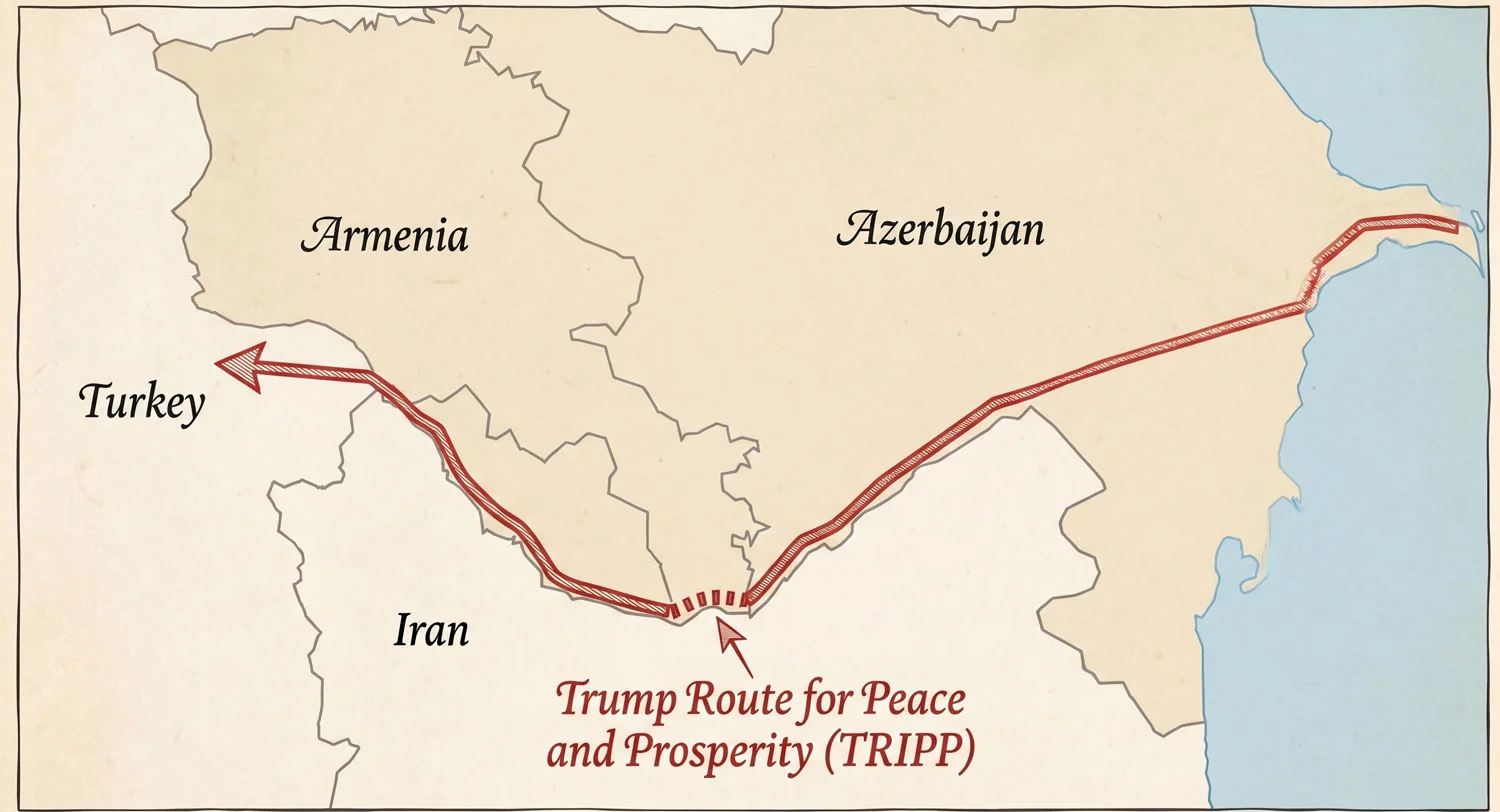
The strangest-named piece of infrastructure in the South Caucasus doesn’t exist yet, and it already reshaped the region’s politics. TRIPP, the Trump Route for International Peace and Prosperity, is the transit corridor through southern Armenia agreed at the August 8, 2025 White House summit, and it’s the centerpiece of the peace framework between Armenia and Azerbaijan.
What exactly was agreed on August 8, 2025?
Three things happened at the White House that day, with President Trump hosting Armenia’s Prime Minister Nikol Pashinyan and Azerbaijan’s President Ilham Aliyev. The two leaders signed a joint declaration, initialed the text of a peace agreement after decades of hostility, and asked to dissolve the OSCE Minsk Group, the mediation format that had limped along since the 1990s. The corridor deal came bundled inside: Armenia granted the United States long-term exclusive rights, reported at up to 99 years, to develop a transit route across its southern Syunik province.
The route got the president’s name attached in the agreement itself. Subtle it is not. Effective, so far, it has been.
Where does the route actually run?
Look at a map of Armenia and find its narrow southern tail, the province of Syunik, squeezed between Azerbaijan on one side and Azerbaijan’s Nakhchivan exclave on the other, with Iran along the bottom edge. Azerbaijan has always been split in two there, and reaching Nakhchivan meant flying or driving through Iran.
TRIPP closes that gap: roughly 43 kilometers across Armenian territory near Meghri, hugging the Iranian border, connecting mainland Azerbaijan to Nakhchivan and, through it, to Turkey. The plans talk about rail and road first, with energy and communications infrastructure in the discussion. For Azerbaijan and Turkey it completes a direct land bridge between them. For Armenia it promises transit revenue and, in the deal’s framing, reopened regional connections for Armenian cargo too, in a country with two of four borders closed for three decades.
How is this different from the “Zangezur corridor”?
This is the part that matters most in Yerevan. For years after the 2020 war, Azerbaijan demanded a “Zangezur corridor” through the same geography, using language that implied an extraterritorial passage outside Armenian control, and backed the demand with threats. Armenia refused flat out. An uncontrolled foreign corridor across your only border with Iran isn’t a road, it’s an amputation.
TRIPP squares that circle with an American workaround: the land stays under full Armenian sovereignty and jurisdiction, and a US-led arrangement holds the development rights and operates the route. Azerbaijan gets its connection, Armenia keeps its territory and legal authority, and an American commercial presence sits in the middle as the guarantee neither side trusted the other to provide. Skeptics in Armenia still worry about what a 99-year foreign concession means in practice. Supporters answer that it beat every alternative on offer, especially the ones delivered at gunpoint.
Why are Iran and Russia unhappy?
Because the deal was built partly at their expense. Iran spent years warning against any corridor along its border with Armenia, which is Tehran’s only friendly land route into the Caucasus. It expected to fight a Turkish-Azerbaijani project and instead got an American one, which from Iran’s chair is worse.
Russia fared no better. The 2020 ceasefire it brokered had assigned control of this very route to Russian FSB border guards. The 2025 framework wrote Moscow out entirely, one more marker of how far Russian influence in the South Caucasus fell after 2020, a slide we trace in is Armenia in the EU or NATO.
About the Albania thing
If you got here searching “Albania and Azerbaijan war,” you’re not losing your mind. While promoting the deal, Trump repeatedly said “Albania” when he meant Azerbaijan, congratulating himself for ending a war between Albania and… the mix-up made headlines and the search data still shows the echo. For the record: Albania is in the Balkans, some 2,000 kilometers away, and has never been at war with Azerbaijan or Armenia. The countries in the actual deal are Armenia and Azerbaijan, whose conflict history is covered in our Nagorno-Karabakh explainer.
Where do things stand in 2026?
The framework has held. The border has stayed quiet, follow-up meetings have continued, and the project has moved into the slow, unglamorous phase of implementation: legal structures, financing, engineering surveys. Corridors of this kind take years to build even when the politics cooperate, so the honest status report reads “underway, not operating.”
What TRIPP has already delivered is stranger than infrastructure: after nearly four decades of war, blockade and displacement between the two countries, from the Karabakh conflict to the 2023 exodus, the operative question between Armenia and Azerbaijan is currently about freight logistics. By local standards, that’s a miracle with a funny name.