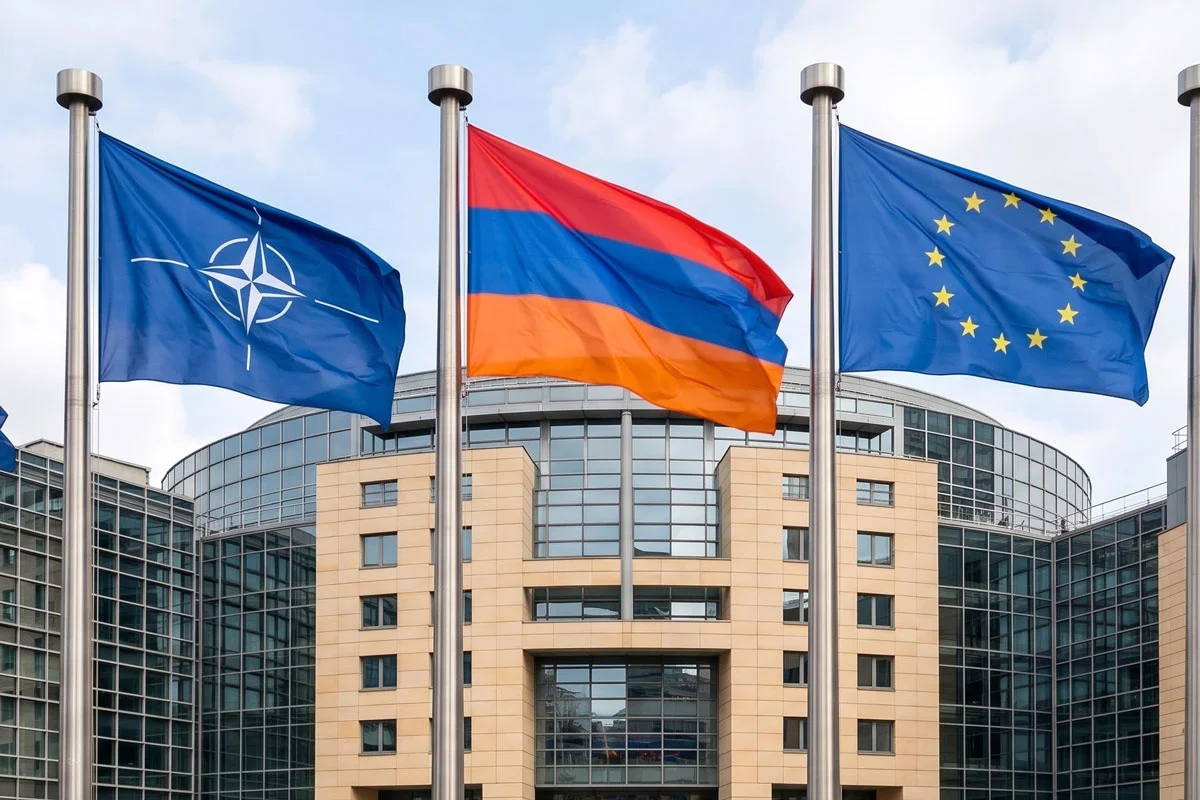
Armenia belongs to neither the European Union nor NATO. That’s the flat answer. The interesting part is that the fuller answer has changed more in the past few years than in the previous thirty, because Armenia is in the middle of the biggest foreign policy turn in its modern history.
The EU: not a member, but now officially heading that way
Armenia is not in the EU and doesn’t hold candidate status. What it has, as of March 2025, is a law, passed by its parliament, formally committing the country to begin the process of EU accession. That made a long-running drift toward Brussels official policy.
The supporting pieces have been stacking up: a visa liberalization dialogue with the EU aimed at visa-free travel, an EU civilian monitoring mission stationed on the Armenian side of the border with Azerbaijan since 2023, and growing EU funding. Public support for membership polls strongly. None of which changes the sober math: accession is a process measured in many years, and Armenia hasn’t formally been granted candidate status. Ukraine, Moldova and Georgia’s bumpy paths show how long the road runs even with momentum.
There’s also a structural snag. Armenia still belongs to the Eurasian Economic Union (EAEU), the Russia-led customs bloc it joined in 2015, and its trade is heavily tied to Russia. You cannot ultimately sit in two customs unions at once. Any serious EU path eventually forces the choice, and Moscow knows it.
NATO: partner, not member, no membership track
Armenia joined NATO’s Partnership for Peace back in 1994 and has cooperated with the alliance for decades, including sending peacekeepers to NATO-led missions in Kosovo and Afghanistan. But it is not a member, has not applied, and no accession process exists. For most of independence, Armenia’s security patron was supposed to be Russia instead.
The alliance that failed: CSTO
Armenia is on paper a member of the Collective Security Treaty Organization, Russia’s answer to NATO. On paper. When Azerbaijan attacked Armenian territory in 2022 and then took all of Nagorno-Karabakh in 2023, driving out its Armenian population, the CSTO did nothing. Yerevan drew conclusions out loud.
In February 2024 Armenia froze its participation. It has since skipped CSTO summits and exercises, stopped paying dues, and its leadership has said the country is past the point of return on the alliance. Formal withdrawal hasn’t happened, but functionally Armenia has walked away, while a Russian military base remains in Gyumri under a bilateral lease running to 2044, one more inherited entanglement that doesn’t unwind quickly.
And the United States?
Closer than ever. Armenia and Washington signed a strategic partnership charter in January 2025, and the US brokered the August 2025 Washington framework between Armenia and Azerbaijan, the peace push that included the TRIPP transit corridor through Armenia’s south. Add expanding cooperation with France on defense purchases, and the picture sharpens: a country rebalancing westward on every axis at once, without yet belonging to any Western club.
The honest summary
Not in the EU, not in NATO, half out of Russia’s alliance, still inside Russia’s economic bloc, and courting Washington, Brussels and Paris simultaneously. Armenia’s geography explains the tightrope: a small landlocked country bordering Iran and Turkey with two of four borders closed can’t afford a clean break with anyone. What it’s attempting instead is a slow-motion pivot, and the next few years decide whether it lands.