Every article on this site about a famous Armenian eventually mentions the same event, because almost every Armenian family in the diaspora descends from someone who survived it. Here is the event itself, plainly told.
Between 1915 and 1923, the government of the Ottoman Empire systematically destroyed its Armenian population. Up to 1.5 million people were killed by execution, starvation and death marches. It was the first genocide of the 20th century, it gave the crime its name, and it created the worldwide Armenian diaspora that exists today.
Who were the Ottoman Armenians?
Before World War I, roughly two million Armenians lived in the Ottoman Empire, most of them on lands their ancestors had inhabited for nearly three thousand years, in the eastern provinces that Armenians call Western Armenia. They were Christians in a Muslim-ruled empire: farmers, craftsmen, merchants, and in the cities a prosperous professional class. Second-class subjects by law, they had already suffered mass violence before, including the Hamidian massacres of 1894 to 1896, which killed at least 100,000, and the Adana massacre of 1909.
What happened in 1915?
World War I gave the ruling Committee of Union and Progress, the Young Turks, both a crisis and a cover. After a catastrophic defeat by Russia at Sarikamish in early 1915, the government blamed Armenian treachery. What followed was not a spontaneous wartime tragedy but a sequence with unmistakable design.
On April 24, 1915, authorities arrested around 250 Armenian intellectuals, clergy, editors and community leaders in Constantinople. Most were later killed. The community was deliberately beheaded first, which is why April 24 is the date Armenians commemorate.
Then came the machinery. Armenian men serving in the Ottoman army were disarmed, moved into labor battalions and executed. In town after town, remaining men were rounded up and shot outside the walls. Women, children and the elderly were driven onto deportation marches toward the Syrian desert, columns that were robbed, raped and massacred along the routes by gendarmes and irregular units. Survivors were funneled into desert camps around Deir ez-Zor, where hundreds of thousands died of starvation, thirst and disease. A 1915 deportation law legalized the seizure of everything the Armenians left behind: homes, farms, churches, bank accounts.
Talaat Pasha, the interior minister and the operation’s chief architect, ran the deportations by telegram. Enver Pasha and Djemal Pasha completed the ruling triumvirate. American ambassador Henry Morgenthau, flooded with consular reports, called it “a campaign of race extermination” while it was still underway. The New York Times ran 145 stories on the massacres in 1915 alone. This was not a hidden crime.
How many died?
The prewar Armenian population of about two million was reduced to a few hundred thousand. Serious estimates of the dead run from 600,000 to 1.5 million, with most scholarship converging on one to one and a half million. Beyond the dead, tens of thousands of women and children were forcibly Islamized and absorbed into Muslim households, and the survivors scattered to Aleppo, Beirut, Cairo, Marseille, Fresno and Los Angeles. That scattering is why more Armenians live outside Armenia than in it a century later.
What happened to the perpetrators?
Briefly, courts. Postwar Ottoman tribunals in 1919 and 1920 tried the Young Turk leadership and sentenced Talaat, Enver and Djemal to death in absentia, but all three had fled. The sentences were carried out anyway, unofficially: Operation Nemesis, a covert Armenian campaign, assassinated Talaat in Berlin in 1921. His shooter, Soghomon Tehlirian, was acquitted by a German jury that heard the evidence of what Talaat had ordered.
The legal aftermath reached further. Raphael Lemkin, the Polish-Jewish lawyer who coined the word “genocide” in 1944, said he formed the concept partly from studying the Armenian case. And in August 1939, briefing his commanders before invading Poland, Hitler is recorded asking: “Who, after all, speaks today of the annihilation of the Armenians?”
Why does Turkey deny it?
Successive Turkish governments acknowledge Armenian deaths but reject the word genocide, disputing intent and numbers and framing the events as wartime chaos that killed Muslims too. The denial is bound up with the republic’s founding narrative and with property: recognition would raise questions about restitution on a vast scale. Denial remains official policy, actively funded and lobbied for abroad, which is why recognition fights still happen in parliaments a century later. Azerbaijan shares Turkey’s position, a fact that echoes through the Karabakh conflict.
Who recognizes it?
More than 30 countries, including France, Germany, Canada, Russia, Brazil and the Vatican. The United States came late and in stages: both houses of Congress passed recognition in 2019, and on April 24, 2021, President Biden became the first US president to formally call it a genocide in an official statement. The International Association of Genocide Scholars settled the question academically long ago.
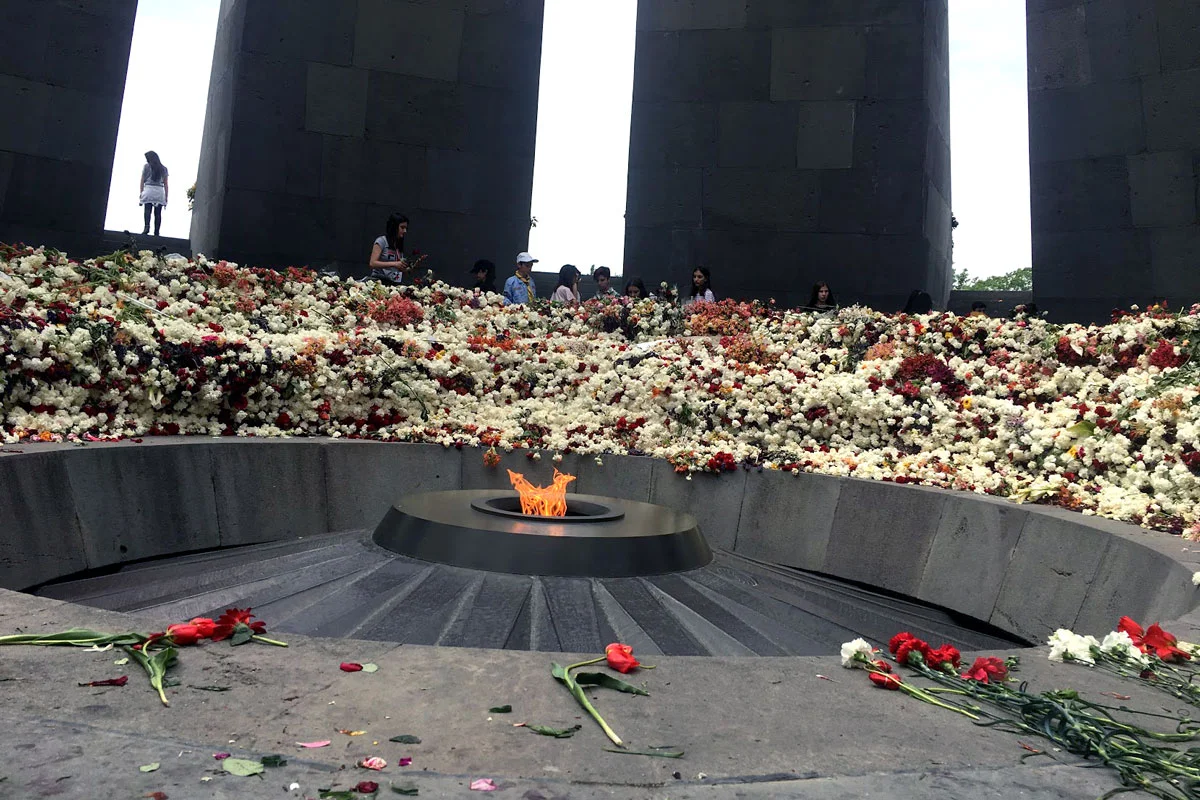
For Armenians, recognition is not abstract politics. It’s the reason Kim Kardashian posts about April 24, why System of a Down toured on the centennial, and why the memorial at Tsitsernakaberd in Yerevan receives a river of flowers every spring. The genocide is the hinge of modern Armenian history: everything before it happened in one homeland, and everything after it happened in thirty countries at once.