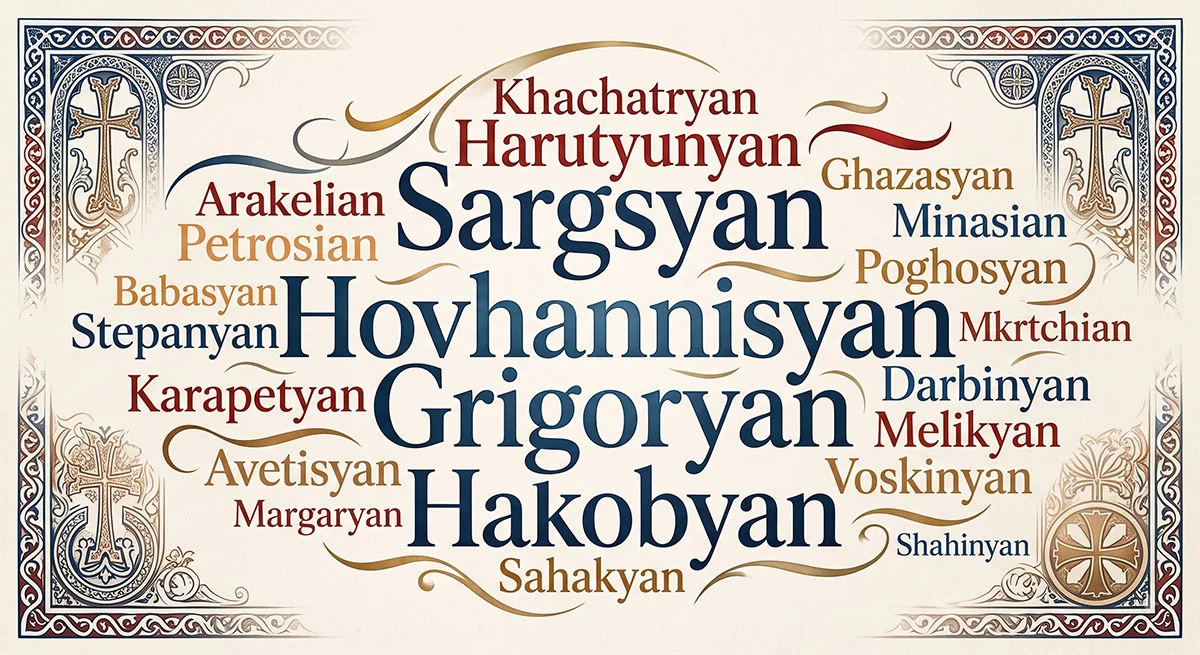
Kardashian. Sarkisian. Tankian. Kasparian. Once you notice the pattern you see it everywhere, and it isn’t a coincidence of celebrity. Roughly nine out of ten Armenian surnames wear the same three letters, and those letters carry the whole logic of Armenian naming.
What -ian actually means
The suffix -ian (-յան) means “descendant of,” “son of,” or “belonging to the family of.” It works exactly like the Scandinavian “-son” (Johnson), the Slavic “-ov” (Ivanov) or the Greek “-poulos”: bolt it onto an ancestor and you have a hereditary family name.
What makes the Armenian system fun is what got bolted. Surnames formed from three main sources:
An ancestor’s first name. Petrosian, descendant of Petros (Peter). Hakobian, of Hakob (Jacob). Sarkisian, of Sarkis, the name Cher was born with and Steve Sarkisian coaches under. Kasparian, of Kaspar, as in Ana Kasparian.
A trade. This is where names become tiny family histories. Kardashian: descendant of the stonemason (“kartash”), fitting for a people famous for carved stone churches and khachkars. Najarian: the carpenter. Boyajian: the dyer. Demirjian: the blacksmith. Gumuchian: the silversmith, which is why the Canadian rapper bbno$, born Alexander Gumuchian, descends on paper from someone who worked silver. Many trade roots are Turkish or Persian loanwords, fossils of the empires Armenians lived under.
A place or status. Names tied to hometowns, or old prestige markers like Melikian, from “melik,” a hereditary prince.
Why -ian in LA but -yan in Yerevan?
Same suffix, two transliterations, one split community. In Armenia and the former Soviet world, the standard romanization became -yan: Petrosyan, Sargsyan, Mkrtchyan. In the diaspora descended from Ottoman Armenians, the older convention -ian stuck: Petrosian, Sarkisian, Kardashian. So the spelling of a family’s suffix quietly tells you which side of the Eastern-Western Armenian divide they come from. UFC fighter Arman Tsarukyan spells it the Eastern way. The Kardashians, whose ancestors fled Ottoman Kars, spell it the Western way. The system is consistent once you see the map behind it.
The names that lost their ending
Here’s the darker chapter. Because -ian identifies a family as Armenian on sight, it became a liability wherever being Armenian was dangerous. Families trimmed the suffix to survive or to blend in.
The most famous case is tennis royalty: Aghassian became Agassi, an ancestor of Andre Agassi dropping the telltale ending to escape persecution. Other families translated their names outright, or had them mangled at immigration desks in Marseille and Ellis Island. Some diaspora Armenians have reversed the edit in recent decades, restoring the -ian as an act of reclamation.
Not every Armenian name has it
A minority of names use older or regional endings: the ancient noble -uni (Bagratuni, Artsruni), the family-cluster endings -ents and -unts found in Syunik and Artsakh. And the reverse trap exists too: a name ending in “-ian” isn’t automatically Armenian (plenty of Persian and some Western names end that way by accident), which is how Giorgio Armani, whose Italian name merely rhymes with Armenia, ends up in everyone’s search history.
Still, as ethnic tells go, this one is about as good as surnames get. See an -ian or -yan, and you’re looking at a compressed genealogy: an ancestor, a trade, a village, and a suffix that survived every empire that tried to erase the people carrying it.