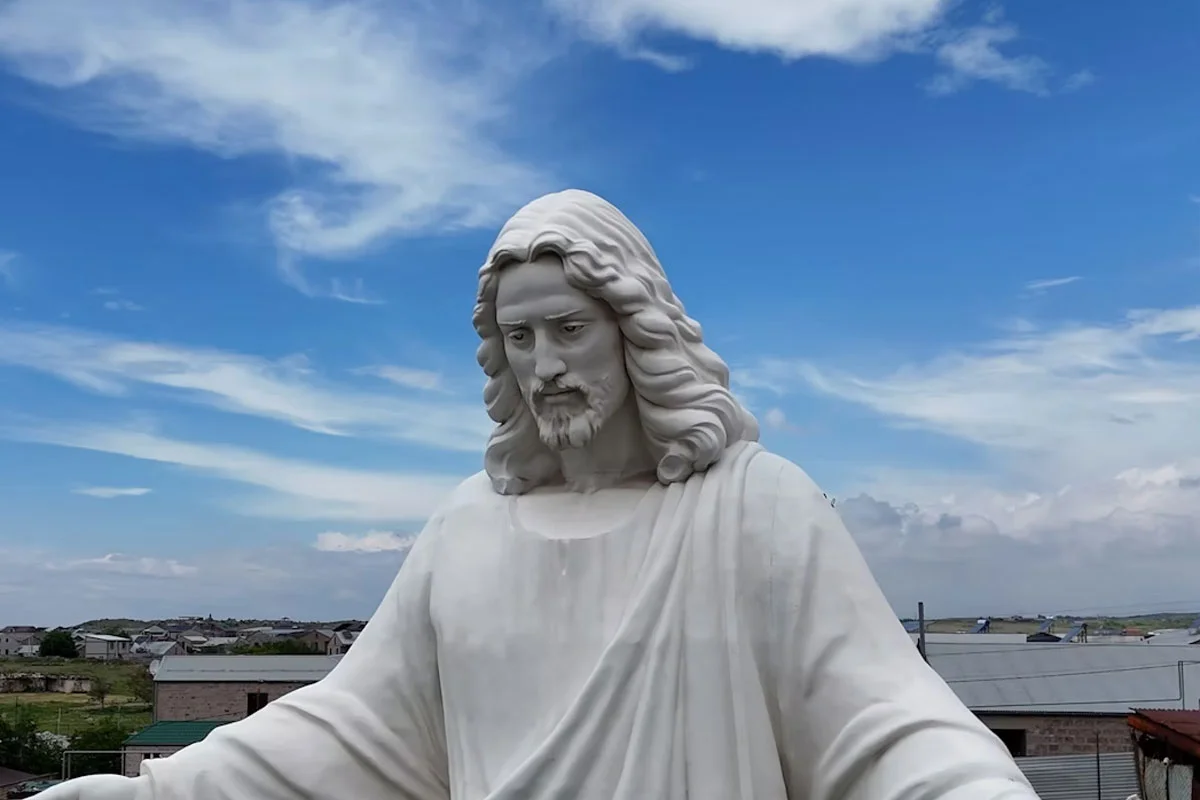
No. Jesus was not Armenian. He was a Jew, born in Judea and raised in Nazareth in Galilee, a speaker of Aramaic living in the Roman-ruled Jewish world of the first century. On the plain historical question there’s nothing to debate, and the Armenian Church itself would be the first to say so.
The interesting question is why so many people type this into Google. The answer is that Armenia’s connections to Christianity are so old and so dense that the wires cross. Untangling them tells you one of history’s better stories.
Confusion source one: Aramaic vs Armenian
Jesus spoke Aramaic. The word sits two letters away from “Armenian,” and the mix-up writes itself. But Aramaic is a Semitic language, cousin to Hebrew and Arabic, while Armenian is Indo-European, an independent branch of a completely different family. The resemblance between the names is pure accident. A first-century Galilean and a first-century Armenian could not have understood each other at all.
Confusion source two: Armenia got there first
Whatever Jesus wasn’t, Armenia’s claim on Christianity is real and unmatched: it was the first nation on Earth to adopt Christianity as its state religion, in 301 AD. King Tiridates III, converted by Gregory the Illuminator after, tradition says, imprisoning him in a pit for 13 years, baptized the kingdom a full decade before Rome’s Edict of Milan merely legalized the faith.
The national church that resulted, the Armenian Apostolic Church, is named for a claim that reaches even further back. Armenian tradition holds that two of Jesus’s own apostles, Thaddeus and Bartholomew, brought the faith to Armenia in the first century and were martyred there. Apostles who knew Jesus personally, preaching in Armenia within decades of the crucifixion: that’s the actual link between Jesus and Armenia, and it needs no embellishment. The full story is in is Armenia a Christian nation.
Confusion source three: the Bible keeps pointing at Ararat
Genesis lands Noah’s Ark “on the mountains of Ararat,” and Ararat is the national symbol of Armenia, visible from Yerevan though standing today across the Turkish border. Armenians took the association seriously enough to name their royal dynasties and their cognac after it, and church tradition says the relic collection at Etchmiadzin includes a fragment of the Ark. Between Ararat, Eden’s rivers (Genesis locates one, some argue, near Armenian lands) and a 1,500-year-old Armenian Quarter in Jerusalem, one of the four quarters of the Old City, Armenia keeps showing up adjacent to the biblical story. Adjacent, not at the center: the Ark landing in Armenia’s mountains still wouldn’t make a Galilean carpenter Armenian.
There’s even a legend of Jesus writing to the region
The strangest thread: church historian Eusebius preserved a tradition that King Abgar V of Edessa, a ruler sometimes described in Armenian tradition as Armenian, exchanged letters with Jesus himself, inviting him to his city and receiving a reply promising a disciple would come. Historians consider the correspondence apocryphal, but the legend was beloved for centuries and pulled Armenia’s neighborhood into the Jesus story within his own lifetime, at least on parchment.
The bottom line
Jesus was Jewish. Armenians were merely among the very first people on the planet to follow him, and they’ve kept at it through seventeen centuries, an alphabet built partly to translate his book, a genocide suffered largely for the faith, and a church older than the concept of Christendom itself. First to sign up is a better claim than a false birth certificate anyway.