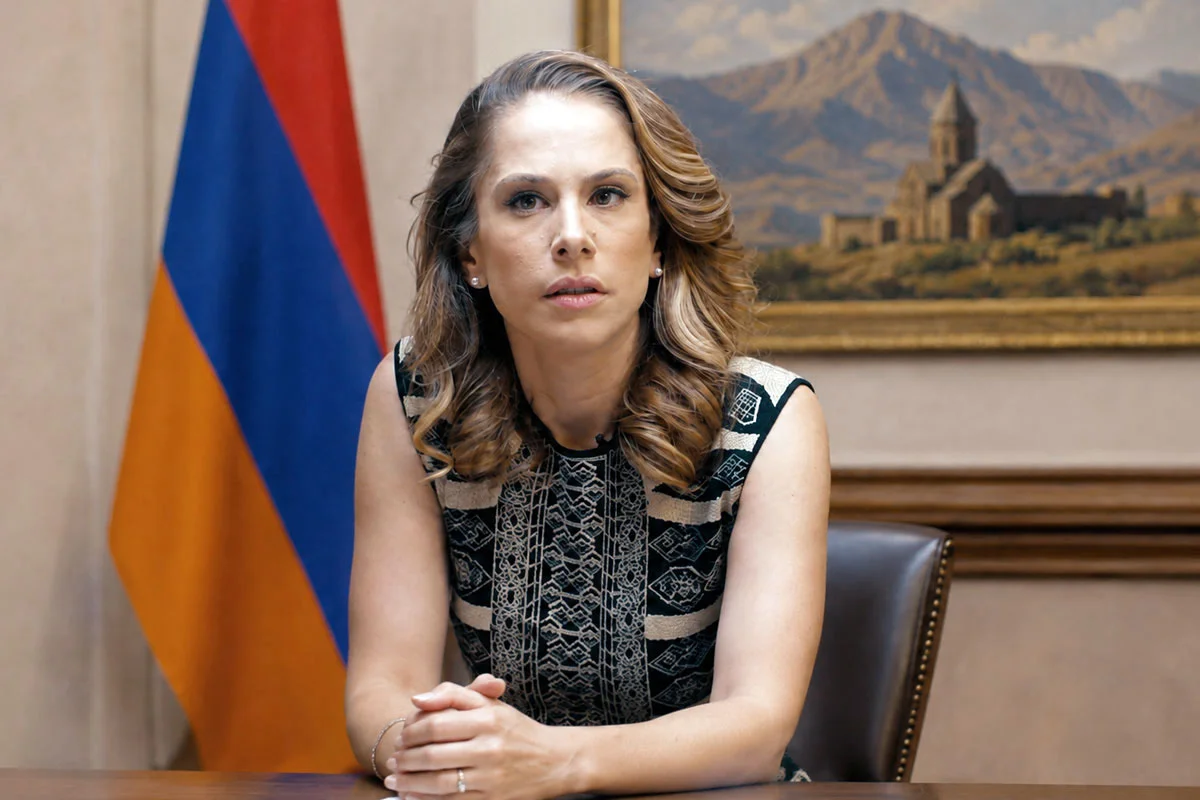
Ana Kasparian has spent nearly two decades arguing about politics on camera, and her surname gives away what plenty of viewers eventually Google. Yes, she’s Armenian. Born July 7, 1986, in Los Angeles to Armenian immigrant parents, raised in the San Fernando Valley in an Armenian-speaking home, and, by her own telling, more fluent in Armenian than English when she started school.
That upbringing puts her at the center of the largest Armenian community in America. LA’s Armenian population, concentrated in Glendale, North Hollywood and the Valley, numbers in the hundreds of thousands, and we cover its scale in how many Armenians live in America.
What does Kasparian mean?
Kasparian follows the standard Armenian formula: the given name Kaspar plus “-ian,” the suffix meaning “descendant of.” Kaspar (Gaspar) is a name with deep roots across the Christian world, traditionally attached to one of the three Magi. So Kasparian reads as “descendant of Kaspar,” the same way Kardashian means “descendant of the stonemason” and Sarkisian “descendant of Sarkis.” The full naming system is covered in why Armenian names end in -ian.
What is she known for?
Kasparian joined The Young Turks in 2007 as a fill-in producer and became the show’s co-host alongside founder Cenk Uygur, helping build it into one of the biggest political shows on YouTube. She studied journalism at California State University, Northridge, later taught there, and has become a distinctive voice on the American left, one who has publicly clashed with parts of it in recent years.
The awkward part: that show name
Here’s the collision that generates half the questions about her. “The Young Turks” takes its name from the Ottoman-era political movement, and it was the Young Turk leadership, the Committee of Union and Progress, that organized the Armenian Genocide beginning in 1915. An Armenian co-hosting a show by that name strikes many Armenians as painful, and the criticism has followed the program for years.
Kasparian has answered it head on. She has said she raised the name with the show early in her tenure, that the show uses the phrase in its dictionary sense of “young progressive rebel,” and that she would not work somewhere that denied her people’s history. The Young Turks has, for its part, publicly acknowledged and condemned the genocide, and Uygur formally retracted earlier writings questioning it. Whether that settles the matter depends on who you ask. Within the Armenian community, opinions run hot in both directions.
What’s not in dispute is her own position: Kasparian has used her platform, one of the larger ones in online news, to call for genocide recognition plainly and repeatedly.
Where she fits among Armenian-American figures
Kasparian belongs to the same generation of LA-raised Armenian-Americans as many of the community’s visible names, from Bailey Sarian in entertainment to the musicians of System of a Down a generation earlier. Different fields, same geography: the Valley and Glendale keep producing prominent Armenians because that’s where the diaspora put down its deepest American roots.