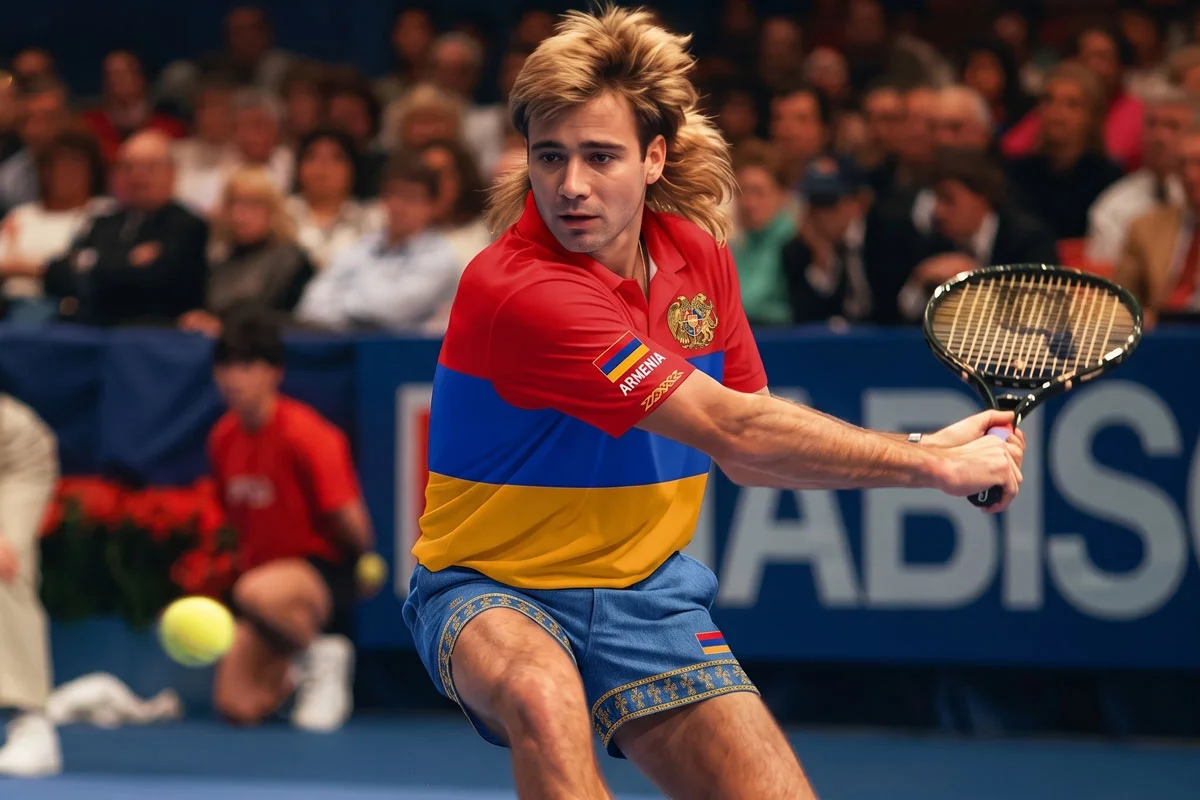
Hidden inside the name of one of tennis’s greatest players is a chopped-off Armenian suffix. Agassi used to be Aghassian. Restore the ending and the question answers itself: yes, Andre Agassi has Armenian roots, by way of one of the more remarkable fathers in sports history.
The father: from Tehran’s ring to Las Vegas
Mike Agassi was born Emanoul Aghassian in Tehran in 1930, into Iran’s Christian minority communities. His mother was Armenian, born in the Ottoman-era Armenian heartland, and his father was Assyrian. That made Mike half Armenian and half Assyrian, a combination Tehran’s Christian quarter produced often, since the two ancient communities lived, worshipped and married side by side.
Mike could fight. He boxed for Iran at the 1948 London Olympics and the 1952 Helsinki Olympics, then emigrated to the United States, won Chicago Golden Gloves titles, and eventually settled in Las Vegas, working in casinos. There he drilled tennis balls at his children with legendary intensity. The youngest, Andre, born April 29, 1970, got the full force of the project: a homemade ball machine the kids called “the dragon” and a quota of thousands of balls a day.
So how Armenian is Andre?
Do the arithmetic across generations. Mike was half Armenian, half Assyrian. Andre’s mother, Elizabeth “Betty” Agassi, is American of European background. That makes Andre roughly a quarter Armenian and a quarter Assyrian, and entirely the son of a Middle Eastern Christian refugee-immigrant story on one side, an American one on the other.
One thing he is not is Persian. The confusion comes up constantly because “born in Iran” gets read as “ethnically Iranian.” Iran’s Armenians and Assyrians are distinct Christian peoples with their own languages and churches, communities that predate Islam in the region. Patrick Bet-David has the exact same Armenian-Assyrian-from-Tehran combination, two generations later.
Why did Aghassian become Agassi?
Survival editing. The “-ian” ending flags a name as Armenian on sight, and in the era of anti-Armenian persecution an ancestor trimmed Aghassian down to Agassi to blend in. It’s a pattern repeated across the diaspora: names shortened, translated or respelled to dodge attention, sometimes reversed generations later by families reclaiming the suffix. The mechanics of those endings are covered in why Armenian names end in -ian.
Does the heritage show up in his story?
Quietly. Agassi’s public identity was always Vegas, the mullet, the rebellion and the redemption, eight Grand Slams, the 1996 Olympic gold, the career Grand Slam. His memoir “Open” dwells on his father’s Iranian boxing past and immigrant drive more than on ethnicity as such. But Armenian communities have always counted the Agassis as their own, the same way they count Cher, another half-hidden Sarkisian. With Armenians, the surname eventually tells, even when somebody sanded the ending off eighty years ago.