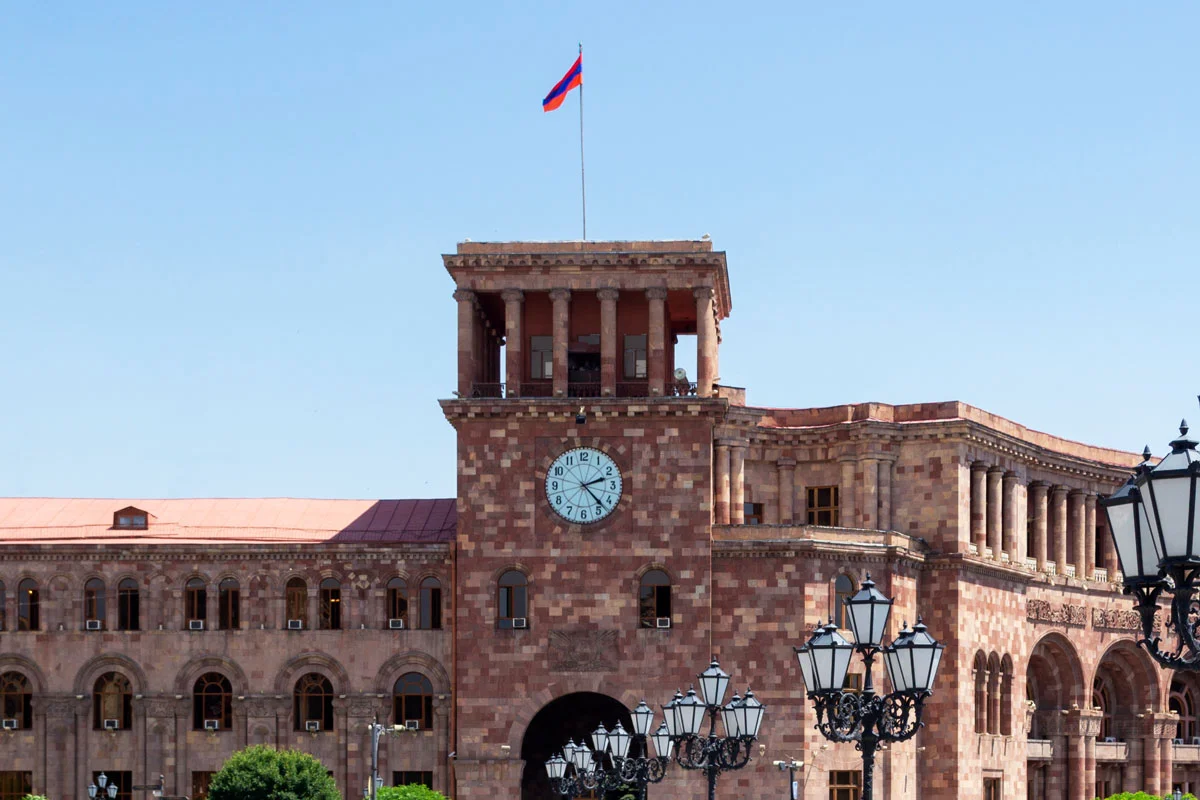
Armenia keeps time the simple way: one zone for the whole country, UTC+4, twelve months a year. No daylight saving, no regional splits, no clock changes to remember. If you know UTC, add four and you have Yerevan.
The time differences that matter
Since Armenia never moves its clocks and most Western countries do, the gap shifts by an hour twice a year, always because of the other side. Here’s the cheat sheet:
| City | Armenia is ahead by (their summer) | (their winter) |
|---|---|---|
| Los Angeles | 11 hours | 12 hours |
| New York | 8 hours | 9 hours |
| London | 3 hours | 4 hours |
| Paris / Berlin | 2 hours | 3 hours |
| Moscow | 1 hour | 1 hour |
| Dubai | same time | same time |
| Tokyo | 5 hours behind | 5 hours behind |
The practical translations: when it’s 9:00 AM in New York in July, it’s 5:00 PM in Yerevan. A Glendale Armenian calling family after dinner at 8:00 PM LA time reaches Yerevan at 7:00 AM the next morning. And Dubai, a major flight hub for reaching Armenia, is a zero-adjustment connection.
Why doesn’t Armenia change its clocks?
It tried, then quit. Like the rest of the former USSR, Armenia inherited Soviet timekeeping habits and experimented with seasonal shifts through the 1990s and 2000s. In 2012 the government scrapped daylight saving entirely and froze the country at UTC+4. The reasoning was the usual one for countries near the 40th parallel: the energy savings were negligible and the biannual disruption annoyed everyone.
Geography backs the choice up. Armenia is compact, about the size of Belgium, so one zone fits comfortably. Summer sun in Yerevan rises before 6:00 AM and sets after 9:00 PM, plenty of daylight without engineering it.
A note for travelers and remote workers
The UTC+4 slot is quietly great for remote work with Europe. Yerevan mornings overlap Europe’s early hours, and a 2:00 PM start still catches the full London workday. Pairing with US teams is the hard direction: a 6:00 PM call in Yerevan is 10:00 AM in New York, and California overlap basically means late nights.
One more quirk worth knowing: Armenia’s neighbors don’t agree on time. Georgia also uses UTC+4, Iran runs on UTC+3:30 (a half-hour offset), and Turkey sits at UTC+3. Drive west across the closed border, if you ever could, and you’d lose an hour. For now, set your watch to Yerevan when you land at Zvartnots and forget about it until you leave. It won’t budge while you’re there.