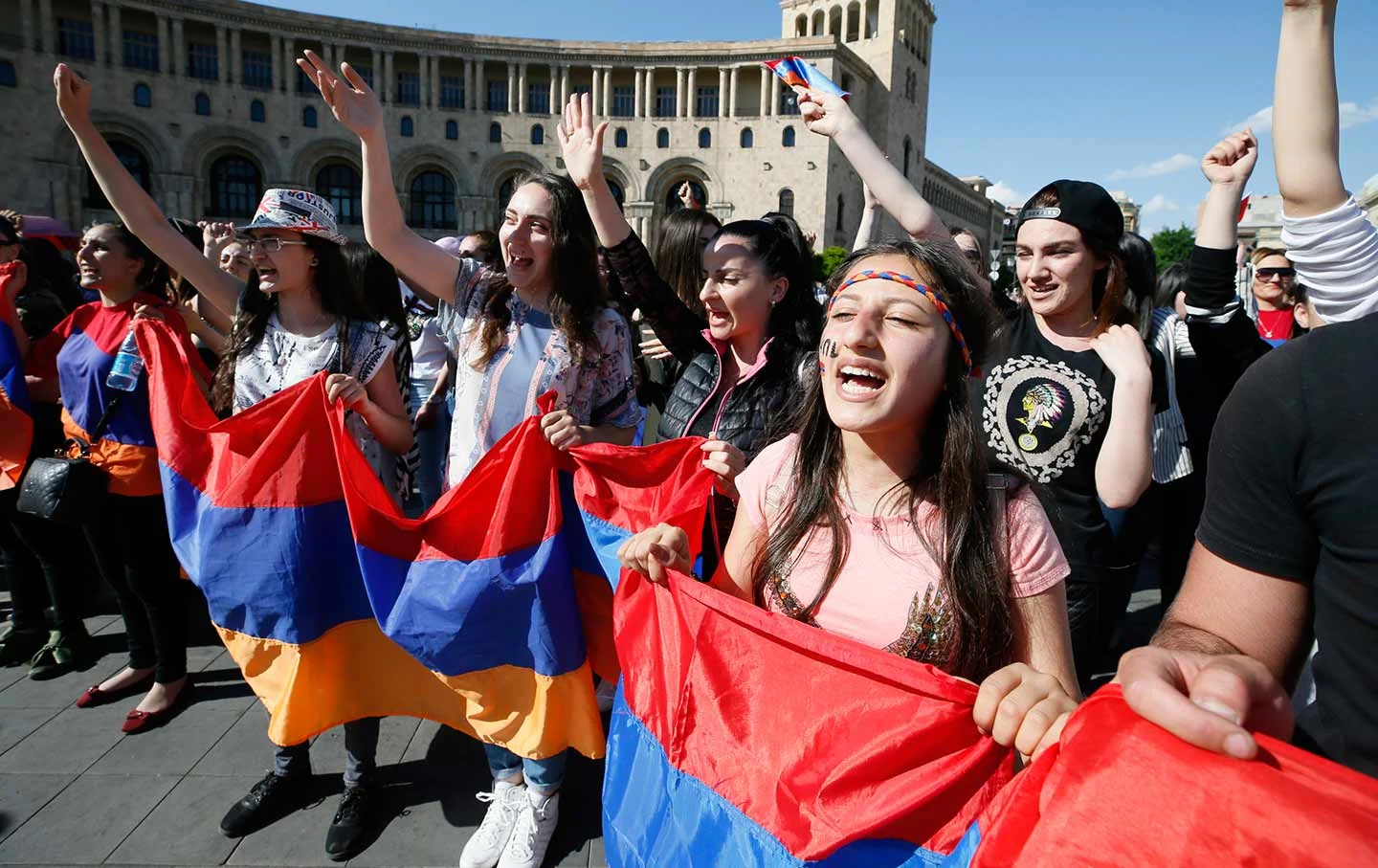
“Are Armenians white?” looks like a yes-or-no question and refuses to behave like one. A US court said yes in 1925. A bouncer in 1910s Fresno might have said no. Plenty of Armenians would answer “we’re Armenian” and consider the matter closed. All three answers are telling you something true, because race is a set of shifting social categories, and Armenians have never fit any of them cleanly.
Where do Armenians actually come from?
Start with geography, since the labels lean on it. Armenians are indigenous to the Armenian Highlands, the mountainous region where modern Armenia, eastern Turkey and northwestern Iran meet. That’s West Asia. It borders the Middle East, sits just south of the Caucasus mountains, and lies well east of anything traditionally called Europe.
For thousands of years Armenians have had their own language (an independent branch of Indo-European), their own alphabet since 405 AD, and their own national church since 301 AD. Ethnically, “Armenian” is a precise answer in a way that “white” never is.
Are Armenians Caucasian?
Here’s a fun irony: Armenians are among the few people on Earth who are literally Caucasian. Armenia sits in the South Caucasus, the actual mountain region.
The racial meaning of the word is a different story. In 1795 the German anatomist Johann Blumenbach coined “Caucasian” as the name for his white racial category, because he judged a skull from the Caucasus the finest specimen in his collection. The term stuck in American English as a synonym for white, long after scientists abandoned the racial theory behind it. So Armenians are Caucasian by geography, and “Caucasian” by the outdated racial label too. One of those facts is solid. The other is 18th-century pseudoscience with good branding.
How did US courts decide Armenians were white?
Because citizenship depended on it. From 1790 until 1952, US naturalization law reserved citizenship for “free white persons” (later extended to people of African descent). Every immigrant group that didn’t obviously fit had its whiteness litigated.
For Armenians, two cases settled it. In re Halladjian (1909), in a Massachusetts federal court, ruled Armenian immigrants eligible as white persons. United States v. Cartozian (1925), in Oregon, confirmed it after the government challenged the classification. The Cartozian defense called witnesses including Franz Boas, the era’s most prominent anthropologist, and won. Tatos Cartozian, a Portland rug merchant who had fled the massacres in the Ottoman Empire, kept his citizenship.
Those rulings mattered enormously. At the same moment, courts were denying naturalization to Japanese and South Asian applicants (Ozawa in 1922, Thind in 1923). Legal whiteness gave Armenian genocide survivors arriving in America a door that stayed shut for others.
Are Armenians white or Middle Eastern?
Both labels circulate, and neither is wrong. Geographically and culturally, Armenians are a West Asian people with deep ties to the broader Middle East, where large Armenian communities have lived for centuries in Lebanon, Syria, Iran and elsewhere. Administratively, the US census counts people of Armenian, Arab, Persian and Turkish origin alike as white, a holdover from those early court rulings.
Daily experience sits somewhere in between. Armenian Americans with dark features and an unfamiliar surname don’t always get treated as unmarked “white,” and the community’s history includes real discrimination, from Fresno housing covenants in the early 1900s onward. Legally white, socially conditional is a fair summary of the historical experience.
Are Armenians Asian?
Only in the atlas sense. Armenia is in West Asia, so a strict continental reading says yes. But when American forms and everyday speech say “Asian,” they mean East and South Asian ancestry, and Armenians fall outside that in every classification system in use. Nobody checks “Asian” for an Armenian grandmother.
What do Armenians say?
Ask an Armenian what they are and the most common answer is simply Armenian. That identity carries a 3,000-year history, a genocide survived within living family memory, a global diaspora bigger than the homeland, and its own language, script and church. Broad racial categories were built elsewhere, for other purposes, and Armenians got sorted into them after the fact. Some embrace white identity, some claim Middle Eastern or West Asian, many shrug at the whole question.
The checkbox is a fact of paperwork. The identity underneath it was never in doubt.